
MoneyStory: This 30yr Old Was Making ₦5M a Month. Then Crypto Humbled Him
MoneyStory by Olaitan Olushola, . 15 min read.

Age
30
Occupation
Gadget seller and crypto trader
Location
Abeokuta
Housing
Squatting with a friend
Total Losses:
₦18.7M
Current Savings
₦0
Take us back. What was life looking like before everything went wrong?
Life was genuinely good, honestly. Not private-jet good, but the kind of comfortable that feels very real when you remember where you started from.
The gadget business was running steadily. I had suppliers I trusted, customers that came back regularly, and a system I understood. Crypto was also performing well for me around that period, so money was coming in from two directions at once. There were months I made ₦4M. Some months ₦5M. A few times even more, depending on what was moving in the market.
I could restock without stress. Pay rent and bills without calculating. Send money home when family needed it. Save on the side. I wasn't a loud spender at all and that's the part that still stings when I think about it now. I wasn't buying designer things or doing owambe every weekend. Most of my money went straight back into the business or into trading because my whole mindset was long-term. I genuinely thought I was being smart.
At that point in my life, I thought I had figured things out.
So when did the cracks start showing?
Crypto. That thing humbled me in a way I didn't see coming.
It didn't look serious at first. The market started dipping and, like any trader who has been through cycles before, I told myself it would bounce back. That's the thing about crypto, it trains you to be patient through dips because historically it does recover. That same psychology that made me money before is what destroyed me later.
The first real mistake, the one that started everything, was when I moved business money into trading.
I had about ₦23M that was tied to gadget business operations and some of it was my working capital, some of it was customer payments for devices I was supposed to source and deliver. I moved it into trades because I was confident. I had recovered losses before. I had made big returns before. In my head, I wasn't being reckless. I was just leveraging an opportunity.
That's the honest truth of how it started. Overconfidence.
How did it go from one bad trade to ₦50M in losses?
The real problem wasn't even the first loss. The real problem was how I responded to the first loss emotionally.
When the market wiped a large amount, instead of stepping back, accepting it, and reassessing everything calmly, I entered what I can only describe as recovery mode. Every morning I woke up thinking about how to get back to where I was before. Every trade after that wasn't normal trading anymore it was emotional. I was chasing what I'd already lost.
And once desperation enters your trading decisions, your entire thinking changes.
You stop respecting your own risk rules. You start increasing position sizes because you feel like smaller trades won't recover the losses fast enough. You start believing that one big win will reverse everything and put you back on track. Your brain stops calculating properly because it's running on fear and ego at the same time.
So after losing the first large amount the business and customer money I started using my personal savings to try to recover quietly before customers started asking questions. Those losses entered too. Then more money followed. Then more losses followed that.
Before I finally accepted that I had to stop, I had lost over ₦50M total across everything. My own savings. Business capital. Customer money. Everything.
There are still days now when that number doesn't fully feel real.
Why didn't you stop earlier? At some point you had to have known.
Pride. Fear. And the kind of denial that doesn't feel like denial while it's happening.
Because how do you calmly accept that years of work disappeared? That's what people who haven't been in that situation don't fully understand. When you've been making money consistently, your brain keeps feeding you the idea that recovery is still possible. It lies to you with your own track record. "You've come back from losses before." "You know this market." "Just one more move."
I kept making deals with myself. Just recover this week's loss first. Just balance this one account. Just get through this month. Everything felt temporary in my mind. Meanwhile, the destruction was already becoming permanent.
It's not stupidity. It's a psychological trap, and it's a very effective one.
When did debt enter the picture?
When customers started calling about their devices.
That was when reality stopped being something I could manage inside my own head. Because now it wasn't just market numbers on a screen. It was real people, real expectations, real money that wasn't mine to begin with.
The calls started politely at first. "Boss, any update on the order?" "When should I expect delivery?" "You've not sent it yet?" Normal customer follow-up energy. But I knew what those messages actually meant, and every notification made my chest tighten.
I had already used most of my personal savings by that point trying to quietly fix things before anyone noticed. So when the customer pressure came, I had nothing left to fall back on. That's when I started borrowing.
First it was friends. Small amounts to buy time and settle urgent situations. Then it became people close to me. Then loan apps entered because I had exhausted my personal network or was too ashamed to ask those people again. Then multiple loan apps at the same time because one wasn't enough to cover everything.
And once that cycle starts, borrowing from one place to pay another then it moves faster than you expect. Your debt doesn't just grow, it compounds. Interest on interest. Penalty on penalty. And the more you borrow to manage the pressure, the deeper the hole becomes.
Talk about the loan app experience specifically.
That period of my life was genuinely one of the hardest things I've ever been through.
I'm still owing ₦18.7M combined. That number alone is heavy enough. But the day-to-day experience of being chased by multiple lenders simultaneously is something different entirely.
My phone became a source of dread. You'd wake up before your eyes are fully open, and before you even sat up on the bed, the messages had already entered. "Final warning." "Legal proceedings initiated." "Repay immediately." "Your account has been flagged." Multiple apps. Multiple numbers. The same pressure coming from ten different directions every single day.
Some of them call from different lines repeatedly. Some send messages with language designed to humiliate you. Some threatened to contact my family members and people saved in my phone. Whether they actually would or not, the threat alone is enough to keep you in a constant state of anxiety.
I stopped sleeping properly during that period not regular tiredness, but the kind of exhaustion where your body is lying down but your brain is fully awake running calculations. Who is overdue. Who is about to escalate. Which customer is still waiting. Which friend I've already let down. Your entire existence shrinks into managing shame and pressure at the same time.
Were people around you aware of how bad things were?
Not for a long time.
I hid it well. That's something I've noticed about financial problems they turn people into very convincing actors without them even planning it. You still show up to events. You still respond to messages normally. You still post on your social media like life is moving. Meanwhile, quietly, privately, everything is burning.
Even my closest friends didn't know the full picture for a while. I was just gradually becoming quieter and less available, and people noticed that energy shift even if they didn't know the reason behind it.
But there's only so long somebody can perform okay when their mind is carrying that kind of weight. Eventually the performance cracks.
What happened with your apartment?
I lost it. Couldn't pay rent. That's the short version.
The longer version is that losing that apartment hit me in a way I didn't anticipate, because it made everything real in a physical, visible way. Financial losses can live quietly in spreadsheets and app dashboards for a while. But when you're packing your belongings to go and sleep in your friend's house, there's nowhere left to hide the situation not even from yourself.
I remember sitting in that apartment after most of my things had already been moved, just looking at the empty space. And I kept trying to trace the exact path from "comfortable and planning my next business move" to "cannot afford to renew my rent." The gap between those two versions of my life was less than two years. That sits with you.
How has squatting been mentally?
Honestly, it removes a kind of confidence from you that's hard to explain until you've experienced it.
My friend has been decent this isn't about the person. It's about what your own mind does when you know your stability is borrowed. You start overthinking small things. How long before this becomes uncomfortable for them? Am I being a burden? What happens if something shifts and I have to move again?
You never fully relax. And because you're already carrying financial anxiety on top of it, even small things disturb you more than they normally would. There were days I'd just sit somewhere quiet and stare at nothing because my head felt too full.
Walk us through what your finances actually looked like at the peak. What were you spending money on monthly?
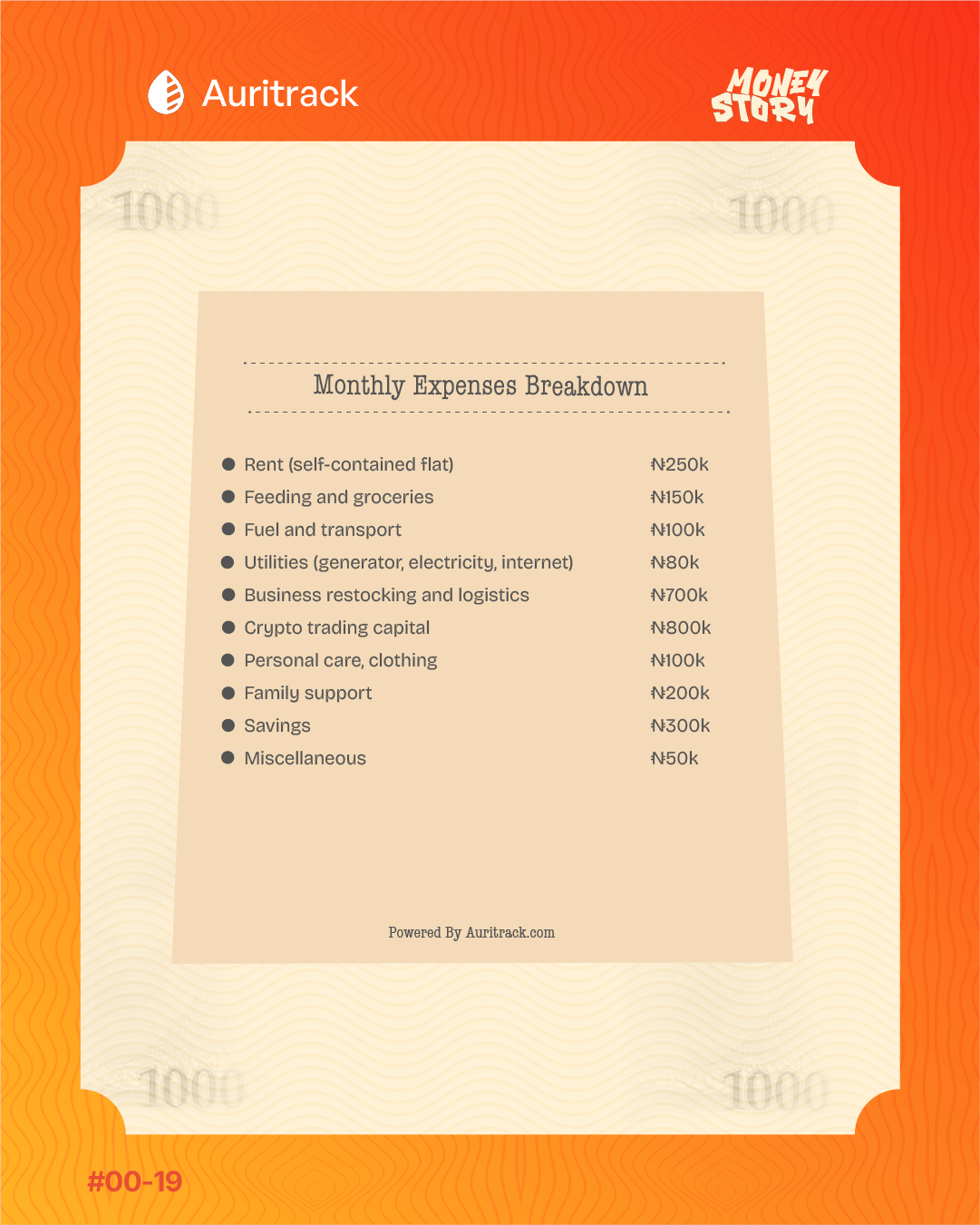
In a good month, after everything settled, I was probably spending close to ₦2.8M and keeping the rest. And before anybody reads that number and assumes I was living large, most of that wasn't even lifestyle money.
The biggest chunks were business restocking and trading capital. I was putting roughly ₦700k back into the gadget business every month, sourcing new stock, handling logistics, settling suppliers. And I was setting aside around ₦800k specifically for crypto trades. So over half of what I was spending was essentially reinvestment, not enjoyment.
Rent was ₦250k. I had a decent one-bedroom flat in Abeokuta; it was nothing extravagant, but my own comfortable space. Feeding and groceries were around ₦150k. Fuel and transport were maybe ₦100k because I was moving around a lot for the business. Generator, electricity, internet, and that whole utilities situation in Nigeria were eating about ₦80k monthly.
Family support was ₦200k. That one was non-negotiable for me. I was sending money home regularly and helping siblings when they needed it. I didn't see that as spending; I saw it as responsibility.
I spent ₦100k on personal care and clothes. And I was saving ₦300k on the side. Then, let’s say about 50k for miscellaneous expenses, because you never know when those extra expenses come.
Do you want to leverage AI in managing your finances? Join thousands of other users already doing this with Auritrack
You weren't living recklessly at all.
If you look at that breakdown, you can see I wasn't the person at the club every weekend throwing money around. The lifestyle expenses were reasonable for my income level. I had savings running. I was reinvesting heavily into the business. On paper, I was doing the right things.
That's what makes this story so hard to tell, honestly.
The problem wasn't the spending. The problem was the risk profile of the reinvestment. I was treating ₦800k in monthly trading capital like it was a fixed business expense, in the same category as restocking, with the same level of certainty, when trading has absolutely no guarantees attached to it. I had just been lucky and skilled enough for long enough that it started to feel guaranteed. That is a dangerous place for any trader to reach.
Did you have a budget? Were you tracking any of this or was it just flowing?
Loosely tracking. Not formally.
I knew roughly what everything cost and I knew my income range, so in my head the numbers always balanced. However, I wasn't sitting down with a spreadsheet every month and reviewing things properly. It was more like money comes in, allocations go out, and whatever is left stays. That system works fine when income is consistent and nothing shocks the equation.
The moment something big hit, I had no formal structure to fall back on. No real emergency fund beyond what was in my savings. No rule that said "this business money is untouchable." Everything was just... accessible. And when the panic came, accessible money became dangerous money.
The ₦800k monthly trading allocation — looking back, do you think that figure was too high?
Yes. Comfortably yes.
At the time, I justified it because it was producing returns. Some months, that ₦800k would come back as ₦1.5M or ₦2M, so the logic felt sound. However, I was sizing that allocation based on the best-case outcome, not the worst-case. A proper trading allocation should be money you are genuinely prepared to lose entirely without it affecting anything else in your life. That ₦800k, if it disappeared, would have hurt me; I just never truly believed it would disappear..
The number should probably have been closer to ₦200k or ₦300k maximum. Enough to participate in the market, but not enough to destabilize everything if the market turned. But when you're consistently winning, reducing your position feels like leaving money on the table. So you don't reduce it. You keep it the same or you increase it. And that's exactly what I did.
What does your financial situation look like right now?
I'm trying to slowly rebuild the gadget business from scratch. The customer trust I lost will take time to repair some of those relationships are probably gone permanently, and I've accepted that. But there are still people willing to work with me, and I'm being very careful this time about what I promise and when.
Crypto is completely off the table for now. Not because I think it's impossible to make money from it I know it's possible, I did it before but because I know myself well enough now to understand that I need to be in a much more stable position mentally and financially before I go near it again. Right now I can't afford to lose anything. Every naira I make has somewhere it needs to go.
The ₦18.7M debt is still there. That's not something I can fix quickly. I'm communicating with some of the people I owe, trying to manage it bit by bit. The loan apps are a different story entirely those conversations are harder. But I'm not running from it anymore. Running only made things worse.
What would you tell someone who's currently in the early stages of what you went through?
Respect the first loss. That's the most important thing.
The version of me that could have been saved was the version that took the first big loss, accepted it fully, and stopped. Everything after that first loss was me refusing to accept reality because my ego couldn't handle it. And that refusal cost me everything else.
There's a version of this story where I lost ₦5M or ₦10M and rebuilt. That's survivable. That's a lesson with a manageable price tag. But I kept trading that lesson in for a bigger and bigger loss because I couldn't sit with the discomfort of accepting what had already happened.
The second thing and this is specifically for anyone in business keep your business money and your investment money completely separate. Physically separate. In different accounts with different purposes. The moment I crossed that line and used customer money and business capital for trading, I created a situation where one type of failure could destroy everything at once. It shouldn't have been possible for a crypto loss to affect customer deliveries. I built the system wrong.
And third: loan apps should be an absolute last resort, not a bridge. Once you're in that cycle, it takes everything you have just to stay in the same place. They don't solve problems they just delay them while making them more expensive.
What keeps you going?
Honestly, I can't fully explain it. Stubbornness, maybe. Or the fact that I've seen enough of what giving up looks like to know I don't want that.
I'm 30. I made real money before and I understand how I did it. The knowledge didn't disappear, the capital did. Those are two very different things, and rebuilding capital is possible if I stay disciplined and stop letting fear or ego drive decisions.
I'm not where I want to be. I'm not even close. But I'm still moving, and right now that's enough.
Get featured on MoneyStory
Have a money story of your own? Send it in and it could be the next one in the series.
Share this story
New stories in your inbox
Subscribe on Substack to get each new story by email when it goes up.
Read next

MoneyStory: He Took a Loan for a Camera Fell into Debt Then Made ₦750k in Two Days.
MoneyStory by Olushola Olaitan, . 7 min read.

MoneyStory: She Learned Lashes in School and Now Makes Up to ₦900k Monthly from It
MoneyStory by Olushola Olaitan, . 7 min read.
MoneyStory: How a Mother of 3 Built a ₦900k/Mo Side Business While Working Full-time as a Civil Servant
MoneyStory by Olushola Olaitan, . 10 min read.